Miami Vice

miami-vice-1-789633.jpg

Total Action in that we see the frame existing to contain human movement, and human movement essentially triggering the film into being. We cannot separate the activated film from the active agent. The ‘anti-humanist’ Yuichi Yokoyama’s manga exploits the fragmentedness of the comic format, and Michael Mann’s sense of time is such that it feels fragmented and not at all fluid. Formally dystopian, Mann is everything beyond this. We get the impression that without activity things would cease to be- this is a cinema of instants. Mann’s films are perpetually in media res- his characters struggle to keep up with the turbulence of events; events which are caused by and made turbulent by human agents. Or are these agents playing catch-up to systems out of their control? Time, performance, and movement are all inextricably bound, as they are in the world surrounding the cinema. Capitalism dictates that we choose a profession and reach our potential through it. We are not humans, we are an economic function. Through fulfilling this economic function we can support something bigger than us. To strangers we tell them how we function. In fiction we are not humans, we are a role in the narrative. In histories we are not humans, we are a role in a narrative. Deleuze described classical narrative cinema as ‘movement-image’ (where images are dictated by the causal chain of action) and proposed ‘time-image’ (where images flow poetically and time flows subjectively) as a cure for this sickness. Mann shares Deleuze’s sympathies but dramatises and formalises his nightmare into a cinema of instants. Mann’s cinema is Deleuzian horror. Movement. Image. Function. What is our function? How do we assess how well we are performing our function? The success of movement. Movement is progress. Time is luck, time runs out, luck runs out, time stops. Michael Mann’s films only exist in motion, when they’re being activated by performing subjects. In a cinema of instants, what does it look like when time stops? If we are activating the present, is there a presence when we resist serving that function? What are we without that function?

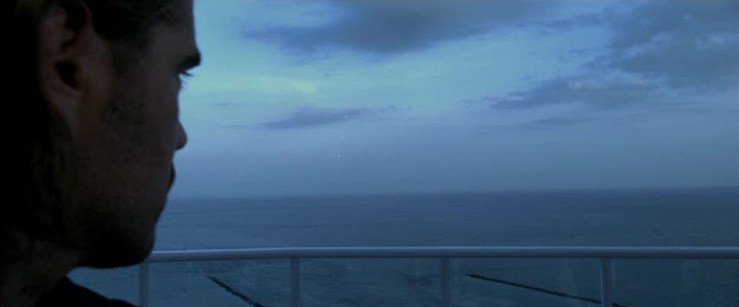
“Economy of time, to this all economy ultimately reduces itself” (Marx), and following that “politics of time, to this all politics ultimately reduces itself” says Lütticken. Who has the time, and who chooses what they do with it? Benjamin proposes a ‘now-time’ echoed in Deleuze’s time-image: the apprehension of the present as an overlapping and clashing of multiple perspectives and temporalities. The present should interrogate the past, and use the past to interrogate itself, in the present. We need to change the way we perceive time. Michael Mann’s cinema is oppressively chronological, and oppressively instant. Capitalism dictates we find and reach our potential. ‘If we’re not in the race, we miss out.’ Miss out on what? Capitalism dictates that we see the world in a state of progress- our lives, our world, and our cinematic works are movement-image. Michael Mann’s characters are good at serving a function. His first film, Thief, is about someone who is good at theft, and who no longer wants to serve that function. Miami Vice is about people who are good at crime and good at being police, and who burst into existence in every frame, trying their hardest to exist. Because to exist is to serve a function. And so things move. ‘Movement is progress’ except when we don’t know where we’re going, or how fast we’re moving. Where are we going? Sunny stares out to the horizon as the story hastens around him. This is not his function. How we’ve seen him, what he’s been asked to do, this is not his function. What he needs to do is to go out there- to the horizon. And he does, once, with Isabella, so they can both become useless. But then again they are activated, and the story hastens around them, and they try to get their heads above the water, to breathe. Because this cinema requires active participants to move, and to move is to exist. But Sunny wants to become useless, and so does Isabella. This is not their function. Miami Vice is about hands clutching hands and about embraces. We act, and the world reacts, and the truth is that above and beyond capitalism everything is in motion at all times. And so we find something to hold onto and we clutch it and we promise that we will never let go. We stop time. To hold on is to resist movement. Our destiny is not to do this- our destiny is over the horizon. But what if one of us lets go. The horizon is a Chekhov’s gun, but perversely it is a promise that can never be kept. Our destiny is to be human, but our fate is that it cannot happen.

To be human is a warm embrace, to be activated to a human end, and to die is to be deactivated. The embrace is activated between multiple participants, and to die is to be deactivated cold and by yourself. Miami Vice is subjective, emotive, and terrified, but it is not subjective cinema. Michael Mann’s films stop moving when they are human, and they pause when humans die. When we’re deactivated the film experiences a glitch and has to look for movement elsewhere, a performance elsewhere, a participant elsewhere. Like unplugging something at the wall, they just stop moving. The embrace is the pulse of Michael Mann’s cinema, and the death is its pause. Its moment of hesitation. It can seem aloof. Mann knows that death is not experienced by the dead, but by those who continue to move around them. His cinema is not interested in death, but in life; in movement. Expressionistic, but ruthlessly bereft of metaphysics. When his characters die, they are no longer moving, and this is our burden to witness. Movement is compulsory, something that is expected of us, which exhausts us, and surviving is less a burden than a tragedy.

The mystery of Miami Vice to me was always why Trudy’s survival weighs heavier than anything else in the film. It’s because her and Rico are still trying to stop time. They still think they can. Their hands are locked, but time keeps moving. To live among ghosts is to move among deactivated bodies. To be activated is to be exhausted, to be playing with time and luck, to explode into existence, constantly, to keep your head above water, to smile and ‘keep up’, to accept that this is your potential, this is your function, not to love and to hold on, but to move, in the service of something else, of invisible machinery, this is the tragedy of movement.


Alien: Covenant

alien-covenant-1-hero.jpg

Super distressing to the point of being like really really depressing? In William H. Gass the author is God because they Create the world out of Nothing, and in Covenant Ridley Scott wonders going on from this what kind of God would be cruel enough to give life to anything, so he names it The Devil, gives it a face, and empathises with it. Bonds are made to be severed, crowds collect for genocide, bodies are born for dismemberment, and faith is offered to be shattered. Or faith is offered to those who are most hurt by this ostensible reality as it stands and want to find God somewhere else, and now this is what God looks like. It is for those who will least like what they see then. This is the film. Covenant is not just about making horror- any creator fits- those peddling soaps and other televisual comforts delegate terminal illnesses to those least able to cope and hack the foundations of the thing until it’s unstable enough to entertain the spectators for whom misery is a kind of fireplace.

Ten years prior to Covenant the ever-masochistic Michael Haneke condescended horror audiences by making the case that his brand of sadism is I don’t know superior or truer than theirs, but ignoring that, Funny Games foregrounded the audience’s role in the work’s creation. Just because God sees us doesn’t mean there’s any compassion in the glance. Following the reception to Prometheus, Scott doesn’t treat us like co-authors, but like a petty group that needs, like the subjects he has built/trapped/tortured, to be punished. To be mocked! He asks repeatedly Is this what you wanted??? And we kind of say Uh well yes but maybe not in this way! I liked Prometheus‘ portentous weirdness but that’s beside the point- nobody’s spared, and in fact in true Covenant fashion, those of us who liked that film will be most horrified by what we find here. In an era of ‘well produced’/’satisfying’/’entertaining’ design by committee epics, it stands out as the kind of film that could only be made by an upset individual with absolute control over what they are doing. That it is a film about precisely this is kind of humorous but still upsetting.

It is not nostalgic for a past where works were made by auteurs (worlds were made by (singular) Gods), but it is an individually horrible shriek through contemporary blockbuster cinema. Returning to that first moment of encounter is impossible and so we do not miraculously ‘discover’ (now familiar) horrors as we did the first time we saw Alien, but just see them re-presented, and the ‘stoner philosophising’ of Prometheus is not something we the audience do with the characters this time, but watch from afar. So long as we are with Scott then hope and discovery are impossible, and like his characters going through a crisis of faith, when we ask to see our creator he takes us directly there, to David, and David walks us through his laboratory of suffering and says Welcome! before, of course, hurting us. Emphatically unpleasant.

Pain & Gain

paingain.png

Pain & Gain seems to exist somewhere between The Wolf of Wall Street and Spring Breakers, possibly for the way that it closes the gap between film and subject (where one might’ve expected satirical detachment), provoking like the former, the bodybuilders into getting carried away and tripping up, and then stepping in and saying Haha it’s okay, keep going! Here I’ll help you… and so they do, they go and go! until they stop. It indulges similar excesses to both films, minus Spring Breakers’ celestial poetry, and minus the feeling in the classically literary Scorsese that these things will be indulged until the subjects’ inevitable comeuppance. Pain & Gain is too much of a frantic mess for anything even remotely literary or morally inevitable- it is about ‘doers’ ‘doing’ in a ‘free country’ and it is every bit as terrifying as it promises to be.

The film is charged and selfish with the characters, sweating and pacing through the streets and ogling bodies and crashing around and being stupid and making noise. It is showy and loud with a kind of turbulence that is made from drawing in overlapping but rigidly self-obsessed voices and perspectives and timelines rather than streamlining itself into a single material force a la Fury Road. It is more noise than punk, like if the vilest bros that ever lived summoned the spirit of The Jesus Lizard, or actually if The Jesus Lizard did a 3 disc concept album about bodybuilders kidnapping people. Bay’s experiments with different digital cameras draw attention in their textural dissonance to his expressive shots and the perma-montage angularity of his editing, which is of course pure joy and a nice break from the film’s otherwise intentionally over-saturated palettes and acerbic gaze.

It occasionally falls into the same (trap? I call it a trap, but others disagree) rhythm as The Wolf of Wall Street, that in its commitment to immersive, mimetic modes of description, it becomes inseparable from what it is describing. I understand why this would appeal but it threatens to feel like stockholm syndrome for Family Guy-esque fratbro cruelty (which is why I couldn’t get through TWoWS). This unnerving sense of blurring in art which can then be written off as irony by the artist, is exploited in places where the film mimics Scorseses and Tarantinos and Coens’. One scene blasts the Rolling Stones and dresses that ear scene from Reservoir Dogs up in screwball ineptitude and adds a tough-guy voiceover. If Tarantino is interested in the cutting of the ear, and Lynch is interested in the ear itself, then Bay is interested in why those two are interested in the ear. The film draws attention to how ‘aesthetic’ it is being, but it stays rotten, like the characters. We continue to be ‘jacked up’, ‘winning’, ‘doing’- the music doesn’t drop out, the filters don’t lift, the cameras still roll around and pace, ogling the violence the way they do buff guys and women with no waists, but the visual material has shifted to the torture of something like Saw or Hostel. It’s unblinking, or uncaring, another thrill. The horror of these people is not when we see them exposed, but when we see through their own eyes, joining them for a look in the mirror as it were. Everything breaks through holding it together- we pause but Bay doesn’t. There is a limit to aesthetics, and Bay tests the limits of empathy.

Scorsese frames opulence and excellence as Shakespearean tragedy- we anticipate the sinners’ comeuppance. The Coens ascribe this quality to fate and chaos, not a Christian God, but this inevitability remains. Everything in Pain & Gain is too rushed, too weird to ever seem inevitable. Bay doesn’t play with religion or philosophical Absurdism, and he also keeps these peoples’ lifestyles and personalities from ever seeming appealing or seductive. They are too absurd to be Absurd. They are, rather, deluded, and we are confused whenever their fantasies are actualised outside of their fever dream. There is a great sense of responsibility involved in having your dreams realised, and the world around you can only hope that you are not a monster. These creeps are possibly, definitely monsters, but what they are doing is trying to be more like those they admire. Pain & Gain shares commonalities with Terrence Malick’s Badlands in the way that it keeps these fantasies ‘low’, and never allows its dreamers to reach a high enough stature for a Shakespearean fall. We know that it is dangerous they have realised that they can act within a world outside of their heads, one inhabited by people with their very own hopes and dreams, but it is poignant in both cases when these heroes-certainly-not-heroes welcome capital punishment because it is their proof that they left a big enough mark on the world so as to warrant repercussions. They must’ve, for a minute there, been someone. The difference is that Badlands’ Kit had ‘outlaw’ as one of his fantasies to be fulfilled, and Whalberg’s Lugo settles for it when he just misses out on cowboying his way to entrepreneur and pillar of the community.

The Others

The-Others.jpg

In Jun’ichirō Tanizaki’s In Praise of Shadows the author muses that Westerners compulsively light spaces and scrub surfaces in fear of shadows and grime whereas the Japanese cherish dark interior spaces and the surface discolourations of patina, and that Japanese ghosts take on a physical presence (minus their feet) where ghosts in the West are transparent. Tanizaki is interested in shadowy interior spaces as they tremble with the infinite potential of yet-unencountered spectres, and more than transporting the fear of the outside unknown into the domestic sphere, the sense of terror in interior spaces can be greater than that of the woods outside. Published in 1933, Tanizaki’s book serves better as a discussion of Japanese aesthetics than a thesis on Japanese v Western ghosts, but the author’s interest in fear, familiarity, and the unknown in architectural spaces makes it invaluable for looking at (among other things) horror cinema.

Ghosts in the West have been located in/embodied by architectural spaces since at least the Victorian gothic period, and entered the modern era through the Anglo-Irish big house fiction maybe exemplified by Elizabeth Bowen’s The Last September (1929). Bowen paints the Irish landscape as one of loss, and country houses as living ghosts or ruins. She is interested in ruins of military doing, of migratory abandonment, and of historical erasure. Whatever the cause, they are sites of dispossession and violence, becoming even while lived in, “a traumatic tear in the fabric of time.” Who has been removed to allow for my presence here? Who is still present? Ruins are, according to Kevin Whelantopochrons containing multiple time periods all at once. Ghosts and ruins turn time from something conceptual into something physical, and history from literature into living memory. Recalling Tanizaki’s observation that Westerners are fearful of marks of time in their cutlery and floorboards might seem prosaic or even offensive, but elaborated on we come to consider the modern destruction of old buildings, the clearing of ruins, and the rewriting of histories as grand narratives.

The Others delineates trauma liberated by the arrival of other histories, literally rejecting modernist impulses towards lighting spaces and”eradicating even the minutest shadow.” Like Gosford Park of the same year the house makes pretend protection for its inhabitants as outside of the house conflicts enter the world-stage, the class system collapses, the empire falls, and external forces encroach on this space mistaken as a safe-haven. Its motifs of light and mist are some of the least subtle that the viewer has come across, and the soldier even turns up for that part of the concept. That the soldier must return to live out his own trauma elsewhere is heartbreaking, and enforces the fact that this is strictly domestic. On an intimate level its pacifism has Kidman breaking down and chastising Eccleston’s involvement in a war that had nothing to do with him (contrary to World War II’s depiction in most media as an absolute moral imperative). We see her pain and her feelings of abandonment and it weighs heavily as a sympathetic perspective on family undone by notions of nationhood and heroism.

Like Signs of the following year we are of course expected to think about this familiar/unfamiliar domestic/world dichotomy in light of the work’s creation. Signs has televisions invading the gold-dappled familial home and aliens encroaching on the cornfields, and The Others has the threat of light being let into the house, doors being left unlocked, and wars being fought outside to undo this fragile domestic state. In 2001 Cool Britannia’s hyper-nationalism was finished, ‘information’ was free, and Tony Blair’s New Labour continued its ostensible social progress at the expense of socialism, steering toward unpopular privatisation, and wearing on its sleeves the proud interventionism which had it join arms with the US in the War on Terror. Amenábar’s scepticism was prescient; someone else will have to say whether or not it was fair.

The country house of the United Kingdom was always haunted, and the ground you stand and sleep on is haunted too. If the house is of any significance, then we can identify the ghosts and events through photographs and official records. Aguirresarobe’s cameras quickly have us adjust to the necessarily low-light conditions of the house which works well for the film’s thematic and dramatic elements, but this comes at the expense of Tanizaki’s “visible darkness”- those corners of absence that take on a presence, where our heads fill with the fearful possibilities of what could be hiding there. We are rarely left to use our imaginative capacity as an audience, and in fact starkly overlaid sounds are used to alert us that something is not right so that someone on screen can go and investigate for us. James Wan’s Insidious and Conjuring series have exploited “visible darkness” to varying degrees of success (sometimes offering catharsis in jump-scares), but John R. Leonetti’s Annabelle (2014) forfeits scares actualised for fears imagined. In terms of visual spaces, that film is the true inheritor of what Tanizaki touched on. It is interesting that in The Others, ventures into the garden are never played for scares and in fact on touching the cold, wet grass the feeling of dread dissipates. The threat comes from within, and from the threat of being forgotten and replaced. Gosford Park watched with a detached grin as those old systems collapsed, and Downton Abbey went through the ruins to build a nostalgic fantasy for Keep Calm and Carry On audiences. The Others is anti-nostalgic, fearful, and belligerent. The past is reconciled with the past, but never with the present or the future. Compared again to Signs where that director ends his films with families embracing each other and our hearts race with hope, The Others fills ours with ice as the family repeats “no one can make us leave this house.” Bowen in Whelan, “‘One cannot say that the space is empty’ even when it is gone; the house remains ‘very much alive.'”

Gangs of New York

Gangs Of New York 4.jpg

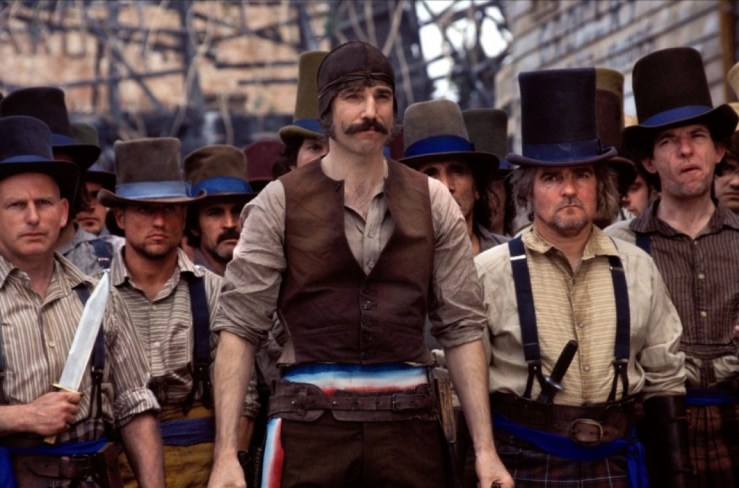
Along with the biopic the epic is without a doubt the most exhausting form that fiction can take, asking its author to rush through time and space, telling only what needs to be told lest we get distracted by the smaller things, and arranging events in a line so that we are given a picture of progress. As the work runs its course, picking up and discarding what it needs to, its audience finds locations, periods, and people that they bind themselves to empathetically, before all is lost to the cruelty of narrative time-keeping. We want to stay a while, or go back, but we can’t. True, controlling the flow of time is impossible in most works, but there is something horrifyingly ineluctable, depressing even, about the charge of time within the epic. Its linearity is more noticeably punishing than that of a non-epic work, because it is always concerned with the passage of time- how people and places change or stay the same. Time in the epic is always in the process of being lost to the next phase; the next image. The epic is built on images of the past that never was, but which we nevertheless desperately cling to in the present. Nostalgia is holding onto visions of the past as the present rots into the future. The epic is the nostalgic genre- its time is preserved but it is never gained.

Gangs of New York is exactly the kind of film that I feel that I cannot bear for the way that it wears me down and exhausts me. It is two and a half hours long but it feels like fifty. Whenever we catch its pace, it runs away again, to the next thing that it needs to be. Because the epic is spectacular, and because it is nostalgic, it is also the Christmas format. Because it is difficult to differentiate in ontological clarity the epic from the adventure or the Western, Gangs of New York is also these things. The streets are built and packed with people and with details, and crowds form around events like the film will soon become a musical. Scorsese is in love with the history of cinema which makes him the perfect director of historical simulacra. He works within the nightmare of the stranger’s photo album or dying vision, to build monuments to these things. He understands, like we do, history through collective memory. Gangs of New York is a theme park built on transgenerational hallucinations- we recognise that our parents and our parents’ parents dreamt it too. We recognise the beat of the thing, we feel its images in our bones, we hum along to it because we along with Scorsese were born into the myths and visions that it evokes. We’ve heard the same songs, seen the same paintings, read the same stories, and done the same work imagining it all to life. In the hit TV show The Knick, Soderbergh tries to keep history alive through memory (which requires a living rememberer), opting for grey tones and shaky-cam to contemporise the past. Gangs of New York on the other hand confidently traverses both memory and mythology. It screams with baroque theatrics and classical training, but it also loses its way in a passion, embarrassing itself, and sometimes it waits patiently, quietly even.

The things in the film which most disorient and captivate the viewer are the things most resoundingly dramatic, and most mythical. Dramatic, small-scale even, is Bill the Butcher reading aloud from the newspaper and for a single word, pausing. We recognise that he is not reading as fluidly as he speaks. This is a powerful individual, intelligent and conniving, but for a second there, he is not fully literate. Or literate, but with literacy as a second language, where his native tongue is words linked with sounds and ideas- in this language his words come freely and he becomes a conductor of ideas and opinions through charged images and rhetoric. He’s educated himself but there’s a glitch- when words are printed on paper they blur and move around the page and make him seasick. This is a beautifully human moment in Daniel Day-Lewis’ predominantly ham performance, but it also means something in terms of the film’s broader treatment of signs and symbols.

The film’s central conflict is between Protestant nativists and Catholic immigrants, staged early in a battle between Liam Neeson’s Vallon and DDL’s Bill the Butcher. Significant attention is drawn later to a mirroring of the two- Bill mentions that Vallon once spared him because he had faith, and scenes later he spares Amsterdam for the same reason. Bill has internalised his faith and is only semi-literate in external signifiers, while Vallon wields literal symbols of devotion. The mise en scene has an emphasis on signs, which signify nothing but a playful semiotics of faith, persuasion, morality, history, and iconoclasm. Its purpose is up for someone better at this kind of thing. Where surface myth and iconography (as opposed to myth and metaphor being unlocked through drama) is concerned we have Liam Neeson heading to battle with a huge stone cross as one of his weapons, abundant Boschian caves which make literal Hells Kitchen, and tangled knotted willows not growing because they’re dead, but just existing all tangled knotted inside by the bar, like an occult shrine or the skeleton tentacles of some old malicious beast. Mike Thorn is very much onto something when he calls this medieval.

Leonardo tries to act louder than DDL which is expected because from the moment he became Scorsese’s muse he became an actor manically devoted to acting well. Few actors other than Leonardo come as close to Nicolas Cage for always visibly acting, but messily and without the smallest bit of compromise diving head forward into performing as someone else. They are always themselves so they never disappear into the role, and watching them kick and scream their way into the frame is so unnervingly sincere that we believe them even as we keep in mind that what we are seeing is just their latest blow-up. A familiarly uncomfortable tantrum with a different costume and accent is always going to seem unfamiliar by virtue of its power to surprise and unnerve us. Their only mode is train-wreck. Leonardo has recently struck a kind of comfort in cartoons such as Candie in Django Unchained and make-pretend auteurist fare like The Revenant, but Gangs of New York finds him at the very genesis of trying to act his way to some higher meaning. Whatever the viewer’s feelings about this kind of performance, it works within the film because we have Leonardo trying to impress Scorsese, playing Amsterdam trying to impress Bill the Butcher. All of his anxieties and shortcomings are manifested in the character and the character’s performance, and so too do those brief moments which convince us that he might be something worth believing in.

Gangs of New York is intoxicating not because it alleviates anxieties over the epic as time-accelerated and time-preserved, but because it openly exploits these fears both gleefully (in terms of cinematic reference points) and mournfully (in terms of history). Scorsese originally came up with the idea for the film through the realisation that he was not the first to walk on the ground beneath his feet. That sounds like the simplest thing, and it is, but listening out for lost voices can be difficult, and hearing them all can be terrifying. The film wants to be about progress, but everybody in the film wants to matter so they won’t be forgotten. They recognise that this might be asking too much. As if the time and events covered by the film are not enough up until this point, Scorsese shuts the theme park down in front of us, tosses the photographs into the trash, and shows us via animated time-lapse how little anybody gives a shit. The hallucination ends for the time being, until we decide that we can stomach going through all fifty hours of its two and a half hour run-time again in the future.

Don’t Look Back in Anger

oasis.jpg

Whatever it meant in 1996 when Noel Gallagher wrote it means nothing and whatever it means now is something else entirely- Don’t Look Back in Anger takes the shambling fin de siècle apocalypse of All the Young Dudes and steers it in a hopeful, structurally sound direction, culminating in this very very very excruciatingly important image: Ginger Spice, David Beckham, Robbie Williams, and Jamie Oliver standing arms linked in the middle of a football field, shadows cast dramatically by the floodlights, singing with us the shitfaced yobbos in the stands this decorated ode to Blair’s Britain. This is the United Kingdom at the Turn of the Millennium.

The previous image of the turn was of an unrecognisable island with Æthelred II raiding and massacring and fighting to Unite the Kingdom of the English, and then in a flash the Battle of Hastings, the Crusades, the Black Death, the Hundred Years’ War, the Protestant Reformation, William Shakespeare, the Atlantic slave trade, the British Empire, the Civil War, the legal theft of the commons and the Agricultural Revolution, the Great Fire of London, the Kingdom of Great Britain, the Industrial Revolution, the Slavery Abolition Act, Chartism, the Education Act, World War I, the Representation of the People Act, World War II, the collapse of the British Empire, punk rock, Thatcher, and finally Cool Britannia.

The Kinks had three decades prior looked over this and produced music which warned of the seductive force that is nostalgia and the Disneyland simulacrum that is national memory, but then ‘the 1960s’ three decades later was taken as a signifier of British excellence through cultural colonisation and compounded with other hollow signifiers to make Ray Davies’ joke a reality. This is the British Disneyland and Ginger Spice, David Beckham, Robbie Williams, and Jamie Oliver singing to Oasis in the football field is the main attraction.

Austin Powers emerges in his blue velvet jacket to say something about Princess Diana, and nobody can tell that he is not James Bond, and Elton John is wheeled out (Vanessa Carlton’s eyes light up) to perform Candle in the Wind 1997. Ginger Spice, David Beckham, Robbie Williams, Jamie Oliver, Austin Powers, and Elton John link arms and and the two on the ends (Ginger Spice and Austin Powers) wave to the crowd who get up and wander into the night chanting the chorus of Don’t Look Back in Anger. Ginger et al. will have five minutes for a glass of water and costume change before doing this again and again until the park closes a few years down the track and is replaced by a city-sized replica of Weatherfield where the Rovers Return is run by the cast of Downton Abbey and every television plays moderately well shot and colour graded Netflix Originals about the royal family.

Blink-182

blink

The only way to understand the weirdness of I Miss You is also the key to understanding how and why Blink-182 exists- it is the product of a band catching wind of burgeoning (fourth wave?) ’emo’ but only conceptually, and preparing a pre-emptive strike on this hypothetical threat. Through this response they show their age and influences, appearing like elder statespeople rather than upstarts. Blink-182 were already well versed in flattening the dichotomies that emo promised it would traverse- self-loathing and fun, melody and ‘punk’, petty relationship woes and mental illness, and so believing that it might not be enough, the band shot for the Cure as well as the Descendents. They rolled out singles the way they always had- with a shithead summer anthem (All the Small ThingsThe Rock ShowFirst Date) followed by an exercise in sap (Adam’s SongStay Together for the Kids), only this time two things had changed. First, the world all but ignored the first single (Feeling This) while the sappy follow-up satisfied if not defined the time/people in which it was received. Second, the follow-up and not the first single was indicative of the record’s tone. Blink-182 is a misguided and unassuming masterpiece pop-punk concept album, liberated and encouraged by the abstract idea of emo within the parameters of the band’s already established sound.

This hunger and anxiety to weather the storm or rise above it account for a ‘Drive’ in the album that is undeniable. Their decision to stand by the past while finding new ways to present it means the construction of new contexts with which to house it- concepts specifically, or downer vibes generally. The shithead anthem opens the album and it’s the last moment of outright shitheaddery that we receive- the conceptual context of the album means that it serves a function within a wider narrative rather than one beginning and ending with the track. It is a plot-point to demarcate a period of hope and happiness before things go sour. The same thing is done by The Beach Boys on Pet Sounds– love or hate Wouldn’t it be Nice, following the trajectory from that song to Caroline, No is part of what makes the album so powerful. With the ‘fun’ ostensibly gone, restless pop punk sections either carry unexpected lyrical weight or take place within a wider sonic palette.

On that first point, Hoppus and DeLonge identify that simplicity was always their strong suit (attempts to deal with things poetically in I Miss You equate to just riffing on The Nightmare Before Christmas rather than penning new pop goth images), expressing thoughts and sentiments without obfuscation. As literary clarity can do, this makes for as much discomfort as it does catharsis (which in itself is ideal) but moments such as Hoppus saving Go from its own mock-upbeat chorus with “Why do evil men get away with it?” is a freakshow awkward move which weighs a tonne. On the second, there are numerous outright formal detours throughout the album, but even when the band plays straightforward and right ahead there’s fetishistic attention paid to the bass and drum sounds; the former grumbles and creaks so organically you can feel the human presence, and the latter opts for space rather than compression. The impact of that space cannot be overstated. This weird sound-fetishism is Sgt. Pepper‘s-ish in its hermetic pedanticism but where that one aimed to exist in a Nowhere Time of schizoid cultural memoria and obsolete cultural artefacts, Blink-182 longs to fit it into a broader narrative of Good Music, calling on the ghosts of shoegaze, goth rock, synthpop, and post-hardcore to stand by them for their opus.

Blink-182 is secretly one of the Great Oddities in music. Its hunger and anxiety to stick it out with emo’s theoretical challenge to the band’s ‘relevance’ (fans already relished the pathos and neuroses of even their stupidest songs) account for its undeniable Drive, but its commitment to the past makes for a sort of identity crisis whereby the record is more and less odd than its weirdo acquaintances- it does not break from form outright as Trans and Low do, nor does it push its popular form to boiling point as does In Utero. It stays within the parameters of Blink-182-the-band, but it tweaks enough for its ‘new vision’ to work. It recontextualises expected forms so that they say something new, while intermittently deviating so that they matter more when they do happen. Blink-182 is not the end-point in a style, movement, or thematic trajectory, but the penultimate step towards that. It is Radio City if Third never came, or My Beautiful Dark Twisted Fantasy from Graduation and never to Yeezus. The traces of collapse are all there, but it took off instead, into prog, which leaves the record as a swansong frozen.

The Wailing

the-wailing.jpg

All the painful deliberation of a police procedural which makes the central descent less obvious, more inevitable, hence the exhaustion that smoulders away at the core of The Wailing. This mock-procedural shambles through the events rather than dictating them, although confusingly, The Wailing is just as much about making decisions as it is about having them made for you by some unknowable external force. This is why it is such a terrifying film. In my engagement with fiction I do not care about the purported consistency of a character’s motivations, and in fact I rarely care about characters or motivations at all really. The Wailing however makes character motivation so important that it cannot be ignored, even as it turns up its sad grim nose at anyone who invests too much in the notion of an individual’s free will within a vacuum. There are crucial moments where it feels as though Jong-goo is about to make an important decision that will alter the world around him, almost like a flowchart, but in retrospect we wonder whether he had any say at all. Jong-goo stares down from the clifftop of possibility over and over again and feels sick with Kierkegaard’s ‘dizziness of freedom’ like a fool trying to do something good for once, but his situation is more analogous to Schopenhauer’s image of the falling leaf thinking to itself “now i’ll blow left, now I’ll blow right” (also a recurring gag in the autumn stretches of the typically bleak Peanuts). In a sense this alleviates the pressure of the individual given that all they can do is react to what came before them and hope for the best, but in The Wailing the devil is winning and he’s taking everyone you love to hell with him. Kim Jee-woon’s I Saw the Devil is comparable for its relentless bludgeoning of the viewer into tired submission, but that film walks with malevolent elegance while The Wailing makes pretend slapstick clumsiness. This is at odds with its visual beauty and the aforementioned deliberation of its unfolding, which hints at a world so considered that The Wailing’s 2.5 hours feels like we’ve spent 10+ in an unfathomably good TV show. Again, this is sadistic because it is all to say that nothing is in our control, that everything can be lost on the devil’s whim, and of course no matter how much we cry that will only be the start because something worse awaits when we realise that we can never save anyone- silence, not wailing.

Star Wars: Rogue One

rogue-one-a-star-wars-story-official-hi-res-hd-images.jpg

Rogue One the film

As with all films made under the conditions of what we imagine to be a director v studio setup, and particularly with a conglomerate such as Disney whose values noticeably manifest in works facilitated by Disney (selling hollow cultural gestures to parents, nostalgia back to everyone), Rogue One is conflicted, but to the credit of the director and studio, it also seems to be the product of Gareth Edwards doing his thing equipped with a checklist of things to include, rather than having to filter every decision through the suffocating vision of Disney.

Its tension is noticeable in the way that it plays out, and it is hard to deny that from a distance it is basically a “content generator”, but Rogue One contains all sorts of triumphs and weirdnesses that make it work in spite of the fact that it, like its characters, is designed to self-destruct. As plotting goes it is systematically ‘canon’, a series of references and actions which assist Episode 3 in getting to Episode 4 (or something), and Edwards cannot help but make breathless work out of reaching each and every one of these points. The film is never allowed to breathe because it is destined to do the grunt work for non-anthology Star Wars, but the unassuming moments and quiet spaces between And Thens transcend this.

Edwards explores horizontals in a way that is refreshing and far less batshit than those in Attack of the Clones. As a director of monster movies, he understands that grounding the viewer is important before introducing verticals. The traditional sublime is felt when the experiencing subject comes upon something which in its enormity either poses a mortal threat to the subject, or which puts the subject’s mortality into perspective as being basically insignificant. Previous Star Wars films have had their ground-level action, but they have also raced us into verticals e.g. the perspectives of pilots, which bring about ilinx (disorientation, tumult, vertigo). It is perhaps impossible to make a Star Wars film without vertical space, but Edwards never indulges ilinx. Rogue One‘s sublime is in scale disparity and not movement. When the four legged walkers approach on the beach they register as monoliths, spine-tingling monsters, and not just targets for pilots overhead. This also adds consequence to the ground combat which some have compared to a videogame and others to a war film. These lines will continue to be blurred the more war footage enters our collective consciousness and entertainment seeks to mimic it, but for now it is satisfying to see e.g. Donnie Yen gripping his staff, Donnie Yen’s pale eyes as seen by Jiang Wen when the ground is calling to him and there is nothing to whisk him away.

Rogue One is designed to appear as though it is subjecting familiar Star Wars imagery to the elements. This is to ‘ground’ the film (along with those horizontals) and signify that it is more downtrodden and resistance-y than the others in the series (see also the Marxist rags costuming of The Matrix). Shadow is applied heavy around Felicity Jones’ eyes to make them appear sunken and perpetually weary, while Riz Ahmed’s eyes bulge pink through insomniac reds. The opening scenes shot in Iceland are powerfully anti-human although Edwards’ anxiety to conform to this aesthetic is evident when Mads Mikkelsen grips young Jyn’s hand and it looks as though the director has just dumped some soil directly onto her knuckles, believing that they were previously not dirty enough. The trajectory of adhering to this can be followed in the state of Jones’ hair (Diego Luna is p much always the same). In Iceland it is matted with that dry frizz identifiable to anyone with long hair that lives in a country whose non-rainy days are ‘spitting’ and whose sun brings humidity, and variations on the dry-frizz-humid look appear in every scene until the point where Jones speechifies about hope etc. From then on it is brushed because now we are in Star Wars and Jyn is a martyr for episodes 4-6. The degree of humid lankness in the cast’s hair is inversely proportional to the degree of Star Wars in Rogue One.

The detours which suffer as a consequence of Edwards having to check the next box still exist in their hamstrung form and still delight the viewer. The search for Saw Gerrera is a terse one with internal conflicts on all sides- he is an extremist of the same cause as Luna, and he rescued then trained Jones as a child. The fear of his ‘extremism’ is suspenseful, and when he interrogates Ahmed he says “you might just lose your mind.” This is jarringly eerie and brings to mind the druggy horror of Kurtz in Apocalypse Now. Whitaker’s unpredictable accent and slow-mo facial contortions add to a sense of unease which suggest that Rogue One could get really weird, which it does, but only within this self-contained Heart of Darkness. Planet Eadu is another inspired element in Rogue One– it is mountainous and dark and always raining, and the architecture is uniformly lined with neons. We will never see it again but it is an exciting one-off inspired by Ridley Scott as much as it is 1980s action videogames.

Whether Edwards manages enough with Rogue One to warrant excitement in the age of Disney Star Wars is entirely left to the viewer, but I love the intimacy, detours, and monster movie-ness which shine in spite of this. If the best we can hope for is that the lower-stakes anthology films give directors a way to avoid pursuing the theme park vacuity of The Force Awakens, then at least that is something.

On the beach, the bored sublime, and the Rogue One billboard beside the New North Road Gull petrol station near my house

The Rogue One billboard beside the Gull petrol station on New North Road has Stormtroopers walking small and apprehensive along a beach, approaching a target (not pictured) with a flat horizon neither high nor low enough to add drama or tension to the picture plane, and the water looks cold and slimy (i.e. real) and the sand looks dirty, and Auckland’s damp atmosphere eats the Death Star and turns the Rogue One skies grey. It is the waste of warfare that the wave crests with nobody to dive into or enjoy it.

The Stormtroopers are the flat shiny icons of popular myth, and so seeing them subjected to the dirtiness and mundane indifference of a flat tide on an overcast day is strikingly peculiar. Past Star Wars posters have conformed to fantasy illustrative tropes, promising iconic, mythological escapism in the form of space opera. When we watch the films they show us the Star Wars universe through the eyes of Chosen Ones and politicians and fighters.

Rogue One is anonymous bodies walking on a beach.

From the Gull petrol station on New North Road the surrealism of this hits the passerby in the stomach. New Zealand is a country of coasts. Its art tradition is dominated by horizontal lines because everywhere you look there is a big wall of ocean staring back at you. We were cursed by Sydney Parkinson on Cook’s first voyage to the Pacific as his Enlightened eye flattened the unfamiliar into knowledge. In the following century artists turned the land into quiet spaces to be rationalised, ruled, and sold.

In the mid 20th century a national Pakeha consciousness began developing through the realisation that we were destined to be “strangers everywhere,” camped out on a beach at the end of the world (a consciousness defined by what Francis Pound called “silence, solitude, and suffering”). Pakeha artists found ghosts in the landscape and they howled through the silence, but then they looked at the landscape flattened into farmland and stripped of its old gods and they thought “we have done this.” This resulted in surreal works which found boredom and fear, the mundane and the horrific, in the landscape. Gordon Walters’ Waikanae landscape found alien forms on the beach and Colin McCahon saw Moby Dick on the horizon, only his white whale was a solution to Pound’s dilemma. McCahon conflated Ahab’s pursuit of Moby Dick with the biblical flight from Egypt, and the New Zealanders’ search for identity. McCahon is the ‘national artist’ of New Zealand precisely because he tried and failed to find meaning (the promised land) for his country.

The image most effectively burned into the New Zealanders’ national consciousness however is likely the ending of Geoff Murphy’s The Quiet Earth. That image does for the anxious New Zealander what the conclusion to Christopher Marlowe’s Doctor Faustus did for its Protestant audience: confirm all of their fears. Its similarity to the Rogue One billboard beside the New North Road Gull Petrol Station is immediate, only the Rogue One poster strikes wider where it is positioned because of its cold and slime and dirt. It recalls Walters’ ‘beach surrealism’ and the dislocated Victorian hangover of the Antipodean Gothic. Murphy’s image descends from McCahon’s, but it is also a literally apocalyptic closure which the artist never found. McCahon and Murphy both saw Friedrich’s The Monk by the Sea, but only the former used housepaint and sand and clay to keep it a part of our world.

The Rogue One poster reminds the passerby that the end will come and she will see it from her shores, but in all likelihood it will be clumsy, on an overcast day, and she will be put-out by the feeling of sand in her clothes, and she will yawn before she’s eaten alive by the hot flames of a fiery hell.

Arrival

arrival

The troubling depiction of Russia and China as wildcards that’ll lead the world to ruin through competition while the US responds to threats with patience and empathy is precisely the kind of paranoid xenophobic awfulness that Arrival preaches against and has basically made 2016 such a terrifying year, which in turn justifies to audiences Arrival‘s self-righteous utopianism. This is more of a contradiction than a palindrome. What scares even more is the part where Forest Whitaker says “remember, the Aboriginal Australians were almost wiped out by a superior race.” Taken at face value Arrival doesn’t motivate or confront anything- it assumes a Western-centric perspective in its audience, pats them on the back, and promises that those crazy Chinese and ‘inferior races’ will someday catch up to its universalist vision (‘universal’, so long as ‘we’ are at the centre of it). If it’s self-critical then the film equates globalisation with colonialism, and statements like Whitaker’s break down the shiny veneer of neoliberalism, exposing the same Darwinist vision as its Enlightenment forebears. What initially seems like propaganda satirises 2016’s rise of nationalism, and problematises the alternative groups (either as closeted imperialists or comfortably out-of-touch). Grim.

Minus Villeneuve’s depressing satire Arrival is a film marked by the director’s inability to decide on a tone, and so fluctuating between clinically detached stylisations and sentimental wonder. Its visuals cut between either longshots or extreme close-ups, the former see the cameras move gently (they never stop) towards framing repetitive Kubrickian symmetrical/centred interiors, and the latter are short-sighted, their shallow depth of field shortcutting intimacy with the camera breathing in and out of focus. This is a rather tired move 5 years after The Tree of Life, and 3 since Man of Steel which imitated Malick’s technique in much the same way that Arrival does, and which similarly sought to balance awe and emotion with fetishistically polished visuals. Arrival has moments of abstract transcendence whenever it allows itself to study the cold textures of spacecrafts or heptapods and Jóhann Jóhannsson replaces manipulative strings with wall-shaking electroacoustic bass tones, but otherwise the film is all said strings and aforementioned visual tropes. Cinematographer Bradford Young knows exactly what will make a good computer wallpaper, often to the detriment of a film- A Most Violent Year was a notable victim of this, and it makes complete sense that he has been hired to shoot a new Star Wars Anthology film given his proclivity for the trendy and vacuous.

As in Interstellar, love and humanity are sort of the epiphanies at the centre of this middlebrow sci-fi, and like Nolan, Villeneuve struggles to find a pulse in his film to give this any sense of consequence. A lot of this relies on the other epiphany- non-linear time, which is introduced by an advanced alien species (as in Slaughterhouse-Five), who are as happy to share their hopeful fatalism as Vonnegut’s Tralfamadorians. References to palindromes and non-linear time are numerous and emphasised, so it is a shame that Arrival is so conservatively linear. True, Adams suddenly ‘remembers’ things, but these are linear scenes inserted in a linear story. Time is only really interrupted during montages, but these are used to narrative rather than poetic effect, to move things along quicker on their linear path. The film begins and ends with narration and the same musical theme (Max Richter’s On the Nature of Daylight which is now as distractingly overused as Clint Mansell’s Lux Aeterna), but montages, narrations, musical motifs, and flashbacks are hardly reserved for films with Arrival‘s aspirations. Its sentiment is made weird by its arm’s-length style, and its style is only rarely allowed to own what it is (alien, detached, curious) before linear narrative impulse and cheap sentiments render it pretty but functional instead.