A Quiet Place

A-Quiet-Place-clips-700x300

A Quiet Place (2018)
Dir. John Krasinski

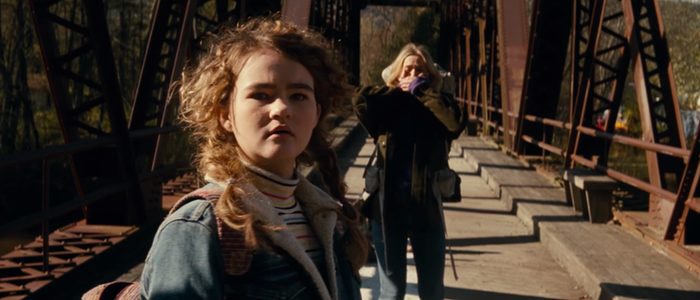
The director-aesthetic is currently en vogue in horror, which becomes knotty with the accompanying ‘thinking person’s’ appendage and late capitalist logic of re-presentations-as-innovation. In a twist to postmodern hyper-awareness, anonymity of craft is still having a financially good run (evinced whenever Bay is reviled and the Russo brothers are celebrated), but in smaller budget genre fare pastiche is frequently mistaken for and celebrated as New. A Quiet Place aims to please new horror audiences while displaying a genuine love of the limits and impulses of the genre that make it more than a cynical exercise. Krasinski’s persistent director-aesthetic openly channels Shyamalan’s visual storytelling, wholesome horror, and pervading disquiet, but he breaks from that director in critical ways. The classical compositions and clean early 20th century editing are all there, but that director’s aesthetic context extends to line-readings and performances where Krasinski favours contemporary ‘realism’ in these areas.

The director being both in front of and behind the camera means that A Quiet Place’s sense of intentionalist authority takes on more of a presence than it might otherwise in the playground of negotiated meaning that is the film- the potential for indeterminacy between collaborators and environments is hushed for a clarity of purpose. A Quiet Place’s thesis reads concurrently in its conceit and between the arched anxious wrinkles and scraggliness of the survivalist patriarch beard. This is not necessarily a bad thing- it is the most critically and commercially successful horror movie in years and has received unanimous praise for its consistency of vision and expression. The supposed brilliance of the film is that it is already its own punchline: whatever you’ve heard, however you go on to describe it to people, the summary sentence of the its Wikipedia page, that is what A Quiet Place currently is. This echoes Shyamalan again who frequently turns up as the punchline to jokes about punchlines. Advocates of that director such as myself find that his works actually open up once the punchline is revealed (i.e. on repeated viewings), and it will be interesting to see in time whether A Quiet Place outlives its format.

The irony of the silence here as others have pointed out, is that A Quiet Place is actually exceedingly loud. This is the result of both Krasinski’s anxieties as a young director, which is understandable, and his decision to opt for performances as performances are understood in 2018. The other director I’ll not name again transports melodrama from the past such that emotions and revelations are delivered with the quiet uncanniness of being out of time, stately and deliberate as the films’ aesthetic context. Krasinski’s is communicated in an anxious rush of sweat, tears, and big gestures. The director uses a specificity of material process, namely survivalist process, but employs breathless emotional shorthand to get the audience onboard almost impressionistically with the plight of the central family. This worked for a lot of people, but I felt as though I was always trying to play catch up to a big self-serious charge that didn’t want to wait for me. Visually as well Krasinski tells us too much in an effort to avoid verbal exposition- the Chekhov’s whiteboard appears once as something that’d make a zombie game safehouse designer blush, and then half a dozen more times as farce. As far as emotions are concerned, Krasinski is already well adept at communicating character relationships through composition and shot sequencing, but he has them sign obvious dialogue as well just in case. Marco Beltrami’s score draws attention to the lack of words spoken by filling the perceived gaps with overwrought music that would not be out of place in a dairy commercial. The lack of spoken words is treated as a challenge rather than an opportunity- the director overcomes the challenge, but he could have done more through believing in himself and the audience, and in all likelihood he will do something truly daring with his next effort.

A Quiet Place’s rift is best embodied in its conceit on one side and Krasinski’s beard and wrinkles on the other. One plays things understated, without words, and the other wants to make sure we’ve noticed, and to guide us in how to feel about things. This tension might have been a more readily exploitable facet if we were able to separate the actor from the vision, namely that the work is silly and the faces play it straight. The way the director sets up scares is similar to the gleeful foreshadowing of James Wan’s films, in that they turn the screen into a funhouse where scares could just as easily be swapped out for physical comedy (as they’re both built on expectation and the release of nervous energy). But the severity of the performances in this film emphasise that it’s for drama, for real human stakes, and this gravity has the audience assessing the realism of the setups, as well as the tangible qualities of the people involved. The logical/causal inconsistencies that are revealed in this process can easily be ignored (my day to day life at least is riddled with plot-holes, obvious lapses of judgement, contradictions of character), but this second empathetic hurdle is more difficult to overcome. To get back to emotional shorthand, this would probably be more easy to get on board with if we were not also told through loud scoring, signing, and performances how to feel about things- it wants to bring us in, but it all kept me at a distance.

It’s a beating generous heart that doesn’t fix anything (nor does it profess to), and it’s perhaps too formally conservative for its own good, but this feels like a compromise drawn from nerves rather than depletion or vision, which then at this point can’t help but suggest that there’s more and better to come, which in the terrain of ironic malaise and amnesiac sound and fury is something worth fighting for and celebrating.

Calvary

calvary.jpg

Calvary (2014)
John Michael McDonagh

It might’ve been funny (it has all the characteristics of a small-town absurdist farce), but Calvary treats its crises and revelations with such a measured severity that it never loses itself to grotesquerie. A priest walks around Easkey which for the way it’s shot might as well be the end of the world, either despised as one of history’s monsters, or pitied as a ghost of loathsome old Ireland (“I’m just a washerwoman, remember?”). He knows he has to die, that he’s a final line to God that no one wants to use, and he’s got a week to get his things in order- an arbitrary time-frame that given the circumstances will be a week-long wait for the inevitable. There’s never a suggestion that the priest is doubting his faith or waiting for a miracle to reveal itself, because Calvary wouldn’t dare provide an argument to move beyond its own impossibility.

Whether or not we recognise the voice of Father James’ killer in the first scene alters the tone of the film (my partner watched a doom-laden mystery while I watched seven episodes of a priest trying to be impartial to his killer), but they ultimately amount to the same thing. He’s impartial because of a detached piety he wears with pride (which it transpires is his undoing), and because he knows better than anyone that if this individual hadn’t put his hand up to do it, somebody else would’ve. Because they’re wrong when they say he’s a ghost that doesn’t recognise that it’s his time to go. Of course he knows what he is. Because everyone wants an answer, and everyone wants someone or something to blame for their shitty lives, and for some it’s not even a case of the parish offering naive promises and blase platitudes, it’s the Catholic church that stands at that point of historical and immediate trauma. A nightmare that time reveals as a systemic evil- something so boundless in its violence that it robs you of your trauma and tells you to take a number and get in line.

The voices of non-believers are many in the film- as this picture of transgenerational abuse and fearful imperialism hardens in mass consciousness they ask what a pious person looks like and how they would respond to this. In Calvary the answer is that he looks like a priest (the sea to his back, torches and pitchforks enclosing), and that he has nothing to say: “This isn’t the mission” “You’ve been reading your history”; “Did you cry when you read about what your priests had done?” “No, I felt detached from it”; and critically “Memories fade” “No, they don’t.” Or, he has a lot to say, but none of it is particularly helpful. At one stage Father James calls the writer character out for saying “one of those things that sounds clever, but doesn’t really mean anything at all,” which is a reflexive moment for the writer-director that doubles as the character’s own confession.

McDonagh’s (stage-)playful writing ensures that Calvary‘s quasi-dialectic feels as though it’s a sparring match when it’s actually a war of attrition- silence would be the bitterest conclusion of all, so Father James busies himself making perfectly phrased sounds to no end, signifying nothing but the negation of silence itself. Because Calvary‘s impossibility is in its immovable negations. The townspeople who loudly reject the church are still bound in their every move to doctrine- their attempts at freedom are expressed through the negation of positive Christian traits rather than something outside of Christianity altogether. Speaking uniformly with writerly elocution, they present arguments for the church’s irrelevance or social harm, and never receive a counterargument. They want to negate Father James, to crush the faith they know is there but which they cannot see, and we want him to negate their cynicism (achieving synthesis), but Calvary is about limits and negatives, not positive answers.

So the ghost-priest, present as his own negation, wanders at the end of the world in the pitch blackness and knows whether or not there’s something there, there’s something there. It’s tempting to think that McDonagh is asking for a thesis for the future, but it seems more likely that for him silence’s negation will suffice.

Manifesto

Manifestopic.jpg

Manifesto (2015)
Dir. Julian Rosefeldt

In general it is worth supporting the right of an artwork to exist, whether the individual(s) behind it are an out of touch once-great artist, a derivative guitar band, a young but retrograde east coast rapper, or a bored grandparent that never picked up an art book but now half a decade into retirement feels an affinity for Pablo Picasso and Henri Matisse. When a major work is criticised for misjudging its time, we can assume it will find an audience somewhere (there is of course the recurring dissonance between critic/public (e.g. Richard Dawson playing in Auckland to a crowd of maybe thirty people, Ed Sheeran selling out arenas and having murals painted of him in Dunedin)), and if not then we can at least believe that the artist felt a sense of satisfaction on seeing their work completed. I believe this entirely- the worst art is not the worst for everyone, and this is why I was so confused yesterday leaving Manifesto‘s multi-screen installation and feeling for the first time that a work might as well not exist. Manifesto is not an ugly work, quite the opposite, it is not without content (the concept makes sure of that), it is no more glaringly useless than any of the aristocratic family portraits that line so many museum walls, and yet it seems to exist as itself and that is all.

Existing for the sake of existing is not uncommon in artist commissions where the artist is basically not feeling the brief or the person/institution behind the commission, but in these cases the means of the (useless) work’s production are not useless- the person or institution gets their artwork, the artist can pay rent and buy materials, and if we’re lucky then the work’s very uselessness will serve a subversive function- to make the work about the cynical transaction behind its own uselessness. But Manifesto is not a commission, it does not think itself useless, and it is blatantly expensive. It is just as stupid to deride blockbuster art as it is blockbuster cinema or pop music, because we should expect some sort of value in what is made regardless of its budget and expected audience. But when a thing looks or sounds expensive, is not about looking or sounding expensive, and expresses very little, it is easy to find oneself distracted by how expensive it must have been to make. Manifesto is too expensive to be ugly. The prologue, Burning Fuse, mistakes tech porn for imagery- it is about expensive cameras, not Marx or Dada, and not Manifesto igniting anything. I heard someone on their way out saying the work was inspiring, but what does it inspire? Does anyone come out of Manifesto a changed person? Anyone with a $30 smartphone has the tools they need to make videos, and anyone with access to a library can find these manifestos, but then comes the hard work: the art. Julian Rosefeldt had access to more than $30, in all likelihood has a library card in his wallet, and he made Manifesto, and that is the story of Manifesto.

As a work of research it is more exciting than volumes on art movements from the early to mid twentieth century. After all there is no Cate Blanchett in those old books, no thirteen screens screaming and fighting for your attention in a space hollowed out and dedicated just to Manifesto. Whole gallery spaces are cleared out to make room for Manifesto, which is a work about Manifesto being inspiring, or about Manifesto being about manifestos. With all of the manifestos at its disposal, all of these burning fuses, Manifesto is Manifesto, just the same as Burning Fuse is about the camera shooting a burning fuse. Rosefeldt’s eye is that of an artist who thinks he’s slumming it in cinema, or a pompous documentarian who wants to be praised for the cinematic qualities of his work. It is all so mannered, so knowingly gifable, so synthetically ‘cinematic’ without a hint of daring, that it feels like a television ad, and hearing the material read in this environment is every bit as queasy as that sounds. Which is not to say that the work is flawless to its detriment- the artist is unsure how to direct Blanchett other than just trusting her to act because she’s an actor, and as such there are passages and whole characters where she is visibly uncomfortable with the lack of clarity on his end. This is fine in Worker in a garbage incineration plant which is her most comfortable role, making small improvised details feel like character vulnerabilities and not film school amateurism.

To return to frivolous art, those portraits of aristocratic families hung in spaces near Manifesto served a function for the families that commissioned them, and the fact that they are now on display for people who never knew the families indicates that they have taken on a usefulness above and beyond that original intention. It could be the artist’s technique, the historical value of the costuming, the gestures and placements of the individuals and what this tells us about family structures there/then, the missing family members that have the family mourning, the typologies that crack the facade of the family unit and expose their hopes and dreams and insecurities. To greater and lesser degrees everything has something to tell us. But here is Manifesto a few spaces over. If we are to agree with Oscar Wilde’s “all art is quite useless,” we can forgive Manifesto for its uselessness, but then also question how mean an artwork must be to collect a hundred and fifty years’ worth of manifestos on art’s usefulness and render them all as television ads advertising Manifesto the expensive useless artwork. As a provocation about the failures of artistic utopias and the victory of vacuous artworks such as Manifesto it actually works, but in the loudest, most expensive, most End of History way possible. This will be the lesson it teaches its future audiences, when it matures to signify more than just itself. Rosefeldt had the budget and the library card, and the reputation to not only get this made, but to have it shown at art galleries and film festivals, so it is frustrating that he has so little to say with that kind of power. The work is broad to the point that it is ineffectual, but as a twentieth century art wikiquote page it is also unbearably elitist. Worker in a garbage incineration plant quotes Robert Venturi: “I am for richness of meaning rather than clarity of meaning,” and it is at this moment in the work that it is clear that Manifesto has in its expensive blasé nothingness neither of these things because it doesn’t mean anything.